Not another Odyssey review!
I am neither a professor of Ancient History who has translated the works of Homer to great acclaim and then developed a bad case of sour grapes, nor am I a self-proclaimed genius trillionaire who must know better than anyone else merely by virtue of having more money than most nations. I do not watch movies set in a historical period expecting archaic language and (erroneous) racially accurate casting. I would not demand that the Creative Arts must never be allowed to interpret the origin material, nor cite so-called evidence that merely revealed my total lack of knowledge of current research. Or any actual evidence at all.
So, what do I know then? Well, I am a historian and author who once (admittedly long ago) studied Ancient and Medieval History with Latin and Greek, during which halcyon time I read Homer, Plato, Aristotle, Sophocles, Euripides, Aristophanes, Virgil et al. I am also a passionate theatre goer who loves nothing more than a fresh interpretation of a great classical work. So, I think my opinion does have some merit in a conversation of this type. Frankly though that’s the problem with opinions these days: everyone has them, and all must be treated equally, regardless of whether said opinion is based on anything as redundant as REAL KNOWLEDGE. In fact, total ignorance seems to be preferred. Experts are probably in the pay of Big Pharma or some other sinister force….
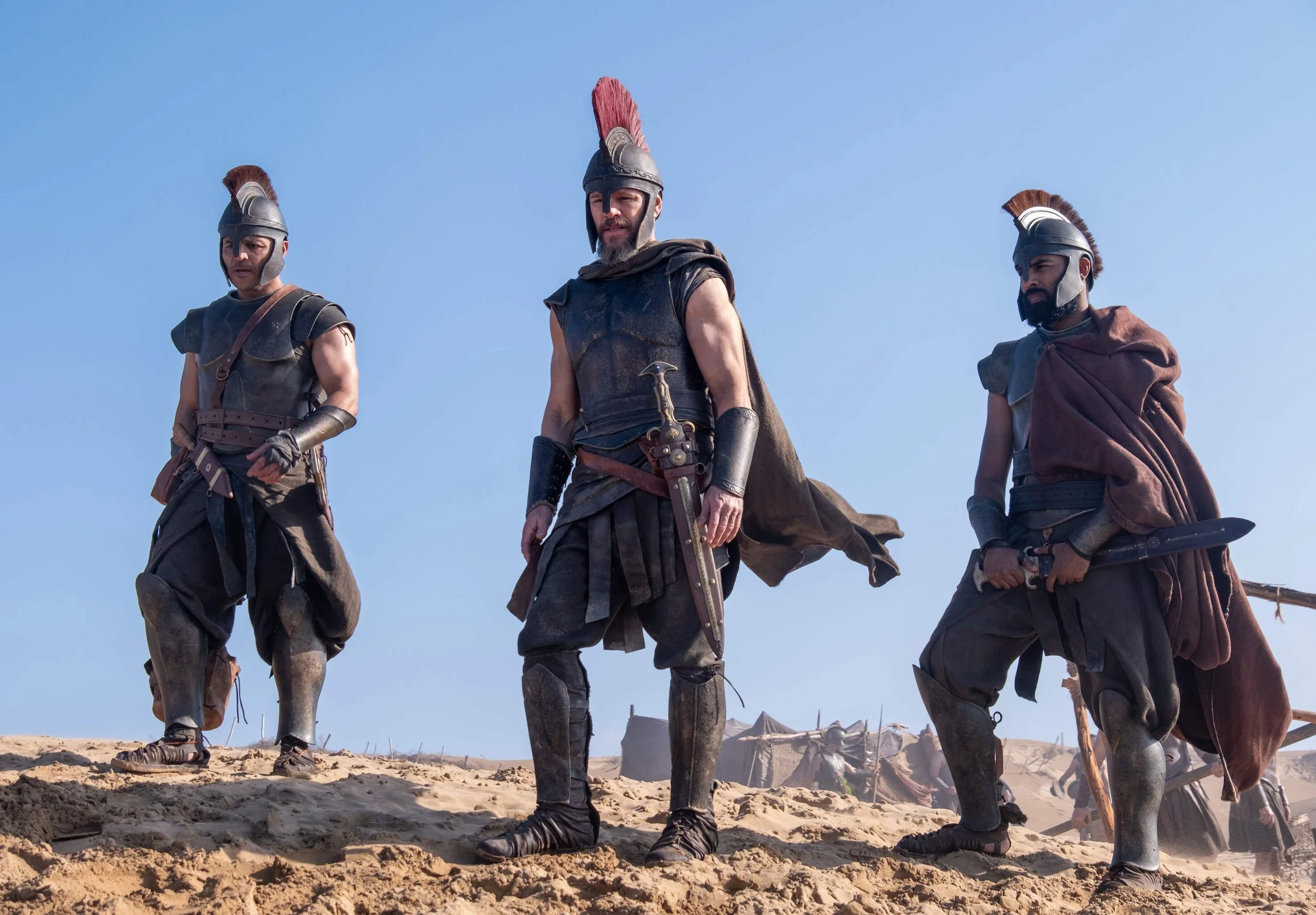
Matt Damon as Odysseus flanked by Jimmy Gonzales as Cepheus and Himesh Patel as Eurylochus
What then did I make of the Odyssey? Well, I hugely enjoyed the movie (for that is what it was), a magnificent spectacle of cinematographic creation, far less reliant on CGI and AI than most modern films and full of interesting – and challenging – new approaches to a very ancient story. Yes, it was long, but not as long as your average binge-watchable Netflix series (only 15 mins longer than Project Hail Mary!) Three hours to cover the entire length and breadth of the vast Odyssey (with a bit of the Iliad and the Aeneid thrown in) is really not a very long time to do justice to an epic. Netflix would have made it last at least 3 series. So, expectations must be realistic, surely? Some omissions must be made, certain episodes would necessarily have to be abbreviated, a simplification of particularly complex aspects is only to be expected. You would imagine. A movie, however, does have the advantage of the visual image– which is where the magic of film lies. And that is exactly what we got, a feast for the eyes containing some of the most vivid, realistic and immersive scenes I have ever seen in a cinema. A book cannot do that. Television cannot do that, however big the screen. So why all the grousing because a movie was a movie?
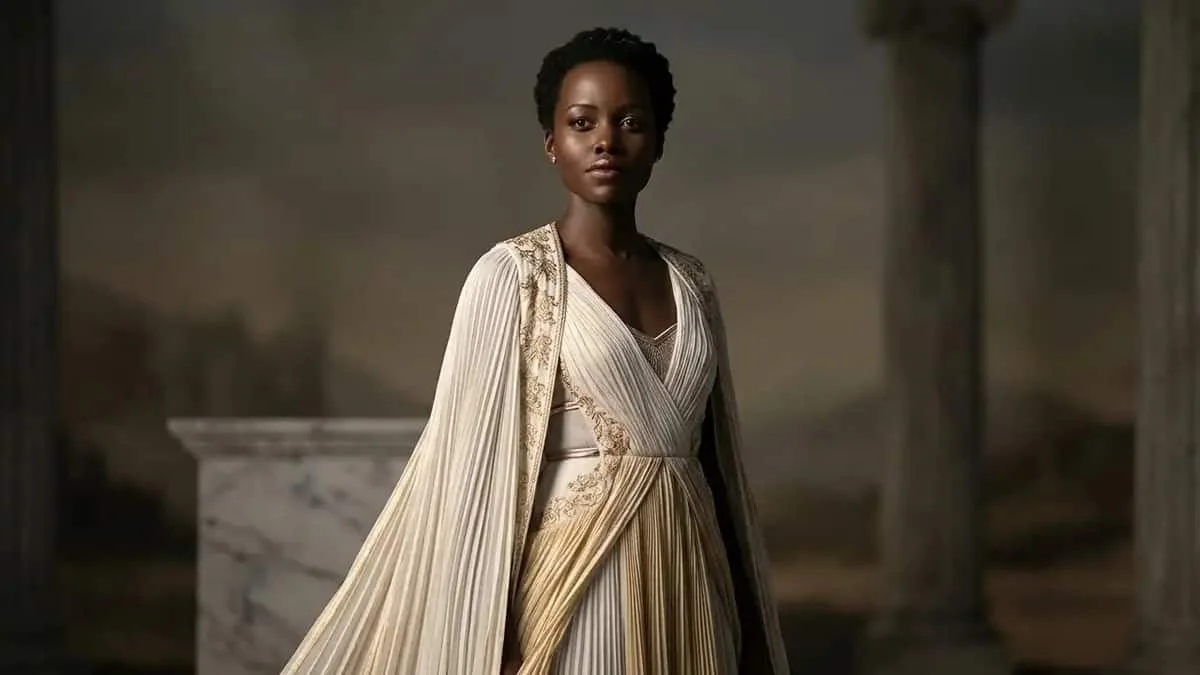
Lupita Nyong’o as Helen of Troy
The Gripes:
Mother (Penelope) and father (Odysseus) were occasionally referred to as ‘Mum and Dad’ by their teenage son Telemachus, which appeared to totally ruin the entire experience for many viewers. Excuse me? The film was in the English language, American English to be specific. Does anyone really think that there were no familiar terms/ pet names for mother and father in the Ancient World? What is this obsession with archaic/ pseudo-Shakespearean language for anything set earlier than the 20th century? The language spoken at any period in time (including when Shakespeare wrote) was the normal language of the day, considered by those who used it as ‘modern’, not ‘archaic’. To make it understandable for today’s audience raised on text talk and short reads, it was decided to render it in contemporary terminology. Perhaps the moaners would have preferred it performed in ancient Greek with subtitles? Of course, they would still have read ‘Mum and Dad’, ‘Maman and Papa’, or ‘Mom and Pop’….because how else to translate the ancient Greek equivalent into modern parlance?
A beautiful black woman played Helen of Troy (and her sister Clytemnestra). How dare she? As we all know, Helen was white and blonde. We all know this – how? Well, because all the earlier movies and TV series say so. I’m not quite sure that Homer ever takes the time to describe her in detail (she is, of course, only a woman so just the conventional niceties will do). She is beautiful, smooth of skin (i.e. no pock marks,) has shining hair…enough to send men off to war to bring her back, that would be all that was needed to be said about her. It’s a legendary epic describing a woman who was hatched from an egg, please! In the Odyssey poem, each reader (or listener ) created their private image of the most desirable woman in the world. But not, apparently, modern movie audiences because they know that the most beautiful woman in the world can only be white and blonde. Just like most Greek women, I hear you say? Grizzly but definitely fair-skinned Matt Damon –once the epitome of the all-American boy–as Odysseus, but no one questioned his suitability as an ancient Greek warrior. Of course not, but Himesh Patel (Eurylochus) –with his thick swarthy beard and deep brown eyes–has been criticised because the actor’s family originated on the Indian sub-continent, even though his look is remarkably similar to that of an eastern Mediterranean, I dare say.
Furthermore, with my historian’s hat on, I must suggest that folks take a look at recent studies of the Trojan war period and the actual status quo of the Greek world vis-a-vis the East and African subcontinent. The Greeks were not much more than uncivilised barbarians to the rest of the civilised world (Africa, Egypt, Persia, the Levant etc.,) Most of what the Greeks eventually learnt (stuff like written script, mathematics, technology, trade and agriculture to name but a few transformative inventions) they took from the great civilisations of the south and east. If there were black queens in Bronze Age Greece, they would have been the daughters of kings of great magnificence and wealth – and thus of remarkably high status. Try ‘How the World Made the West’ by the fabulous Josephine Quinn for starters if you want to find out about the world in which the Odyssey was actually set.
According to ‘canon’, the Odyssey is not supposed to be about war, or a disillusioned warrior, or a hero who comes to understand that it is he and his men who are the uncivilised ‘raiders from the sea’, not the others. In conventional understanding it is the ultimate love story about a man who will do anything to get home to those he loves. Thus, Odysseus is brave, fearless, inventive and stoic (actually a Roman concept) in the face of everything thrown at him, so much so that when he does in the end reach his beloved Penelope and Ithaca, he brings justifiable retribution to those who have threatened HIS world.
But if one actually reads the Odyssey, Odysseus, like many Greek ‘heroes’, appears more as an antihero, a rather selfish, crafty, disloyal,‘complicated' man, who over and over again sacrifices his men to his own desires. He is a philanderer who willingly spends years gleefully bedding nymphs and witches while Penelope struggles on alone. Nolan’s ‘Odyssey’ chooses to portray Homer’s eponymous hero as more of a Maximus figure. One who ultimately learns that the warrior world he has inhabited so long has ultimately destroyed his way of life. It’s a departure from the original, but an interesting interpretation, especially in the light of the world we live in. Each new version of epic is totally justified in reimagining in its own way, adapting the message to the zeitgeist of the time in which it is created. It is never wrong to take a new approach. It is ultimately why great literature is timeless; each era finds fresh meaning and new insights from the astonishing humanity inherent in its storytelling.
With that in mind, let us remind ourselves of the chronology of the Bronze Age. The Trojan War, which probably did take place (but would have been more of a trading/ colonising conflict just as Nolan’s Odysseus wryly mentioned at one moment) is dated to roughly around 1250 BCE. The Iliad and the Odyssey of Homer (whoever he was) were written down around 750 BCE. For 500 years story tellers had woven scraps of historical fact around folk tales, cultural traditions and, of course, myths about the Olympian gods intertwined with local nature spirits.
But that was not the end of the evolution. The great dramatists of the 5th century BCE, (Sophocles, Euripides and Aristophanes and many others, some lost to us), writing 250 years later, used episodes from these Bronze Age epic cycles, re-interpreting the traditional stories for their own dramatic purpose to reflect the world that they lived in. Another half a millennia later, Virgil created his magnificent Aeneid (the Roman origin story, a sort of ‘final chapter’ to the works of Homer), to justify Roman imperium. The Olympian Gods had always planned revenge on the Greeks for the destruction of Troy by creating a new Trojan settlement in Italy: ROME. They just took their own sweet time about it, as Immortals tend to do because time is meaningless to them. Interestingly, many elements of the story of the Trojan war that people think came from the Iliad in fact derive from the Aeneid, inventions of Virgil….So why can’t a movie made in 2026 find its own metaphors from this complex web of legend, story and drama without being accused of betraying the TRUE meaning. There is no truth. It’s a MYTH!
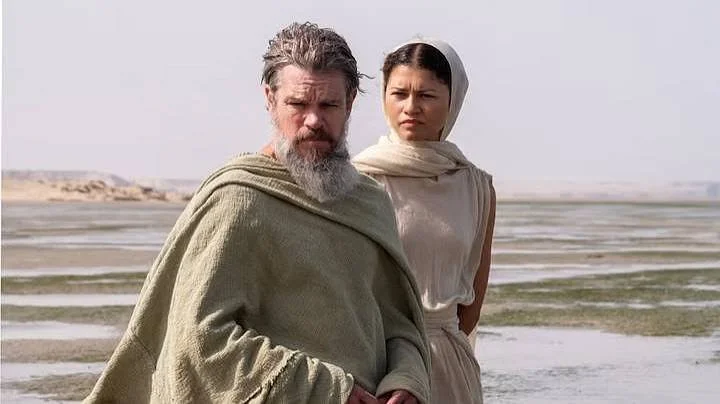
Odysseus and Athena
To conclude, however, although I really enjoyed the movie, of course there were some aspects that didn’t quite work for me set alongside scenes that were absolutely brilliant, which is exactly as it should be in any work of art.
I thought The Laestrygonians episode was pointless and could have been entirely left out. The robotic metal-clad warriors looked like they had wandered off the set of ‘Game of Thrones’ and bore no resemblance to anything we might expect to find in the ancient epic – plus they didn’t even do what they are known for in the Odyssey i.e. eating humans (Cyclops did that spectacularly well the scene before, another reason for leaving them out )
Athena was a disappointment for me even if (SPOILER ALERT) she was portrayed as a mere figment of Odysseus’ guilt over the death of a priestess of Athena on the night Troy fell. Zendaya dressed in a nondescript cloak with no deity-like aura, also appeared to have wandered off the set of another movie: Dune, of course.
I would have preferred a bit more sex. But that’s just me (and Mary Beard, apparently). Odysseus was a real Lothario. Matt Damon’s version was remarkably coy with the ladies.
Some of the performances were rather unremarkable. Charlize Theron’s Calypso looked like she was on the ‘80s hippie trail in Bali or Thailand. Agamemnon was just plain weird. Tom Holland’s Telemachus was too old (laughably) and showed no character development, an aspect of Telemachus that seems particularly central to his coming of age as a warrior. Matt Damon was okay – but he’s no Russell Crowe.
But Circe and Sinon both knocked it out of the park. The grotesque manipulation of ‘human’ clay to transform the crew into pigs was astonishing in every way: visceral, vomit-inducing and utterly spellbinding. It was also what I expect of the always brilliant Samantha Morton. I even forgive the episode for its subsequent lack of any romantic dalliance between Odysseus and Circe as in the legend. And Elliot Page as Sinon proved to be the greatest warrior of all, if true courage, honour and service are its definition. There was much to think about in that particular performance.
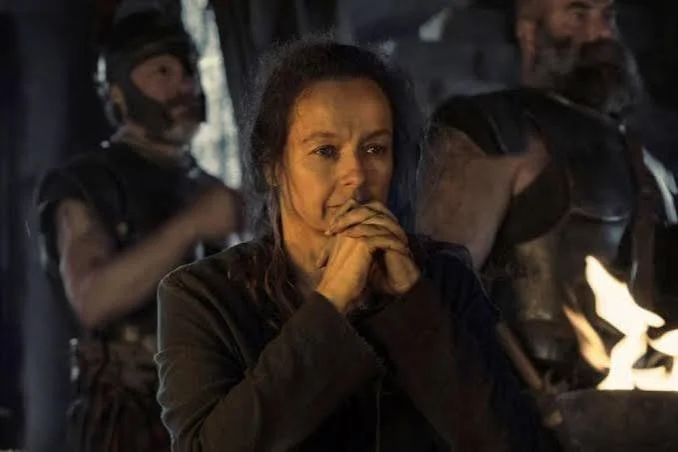
Samantha Morton as Circe
If you haven’t yet seen The Odyssey:
Don’t be put off by the press and social media negativity. Christopher Nolan is a genius. He has more than deserved the right to his own spin on epic legend. The Odyssey is a worthy film and deserves to win lots of awards next year. It is especially deserving if it can generate such an interest in the History and Literature of the Ancient World!